How Much Does It Cost to Install an EV Charger at Home in NJ?
Most Level 2 home EV charger installations in New Jersey cost between $1,000 and $2,600. The price depends mostly on how far the charger is from your electrical panel and whether the panel has room for a new 240-volt circuit. If your home needs a panel upgrade to handle the charger, that is a separate job, quoted as a flat price after we see the panel. Every install needs a township electrical permit, and Spartan Home Pros, a Tesla Certified Installer, handles it for you. Call or text (908) 287-2187.
This guide walks through what New Jersey homeowners ask us most: whether you need Level 2, what drives the cost, which charger and circuit to pick, permits, the rebates that still exist, what happens on install day, and the mistakes to avoid.
In this guide
Level 1 or Level 2: do you need the faster charger?
Level 1 is the cord that came with your car, plugged into a regular wall outlet. It is slow, adding only a few miles of range for every hour plugged in. If you drive less than about 30 to 40 miles a day and the car sits overnight, it can be enough.
Level 2 runs on a 240-volt circuit, the same kind of power a dryer uses. Depending on the car and the charger, it adds roughly 20 to 40 miles of range per hour, so most cars are full by morning. Level 2 is the right call if you commute, drive an electric truck or SUV, have two EVs, or just do not want to think about it.
A third option, the fast chargers you see at highway rest stops, is not something you can put in a house. Home charging means Level 1 or Level 2.
What EV charger installation costs in New Jersey
The charger itself is usually bought separately, by you or through us. What moves the installation price within that range:
- Distance from the panel. A charger on the garage wall right behind the panel is the simplest job. A detached garage, a second-floor panel, or a driveway on the far side of the house means a longer wire run, and sometimes a trench.
- Open or finished walls. Running wire through an unfinished basement or garage is quicker than working through finished walls and ceilings.
- Room in the panel. A Level 2 charger needs its own circuit. If your panel has space and enough power, great. If not, a load management device or a panel upgrade may be needed (more below).
- Indoor or outdoor. An outdoor charger needs weather-rated parts and sometimes a post.
- Hardwired or plug-in. We usually recommend hardwiring. More on that below.
You always get a flat price in writing before we start. No hourly meter, no surprises on the invoice.
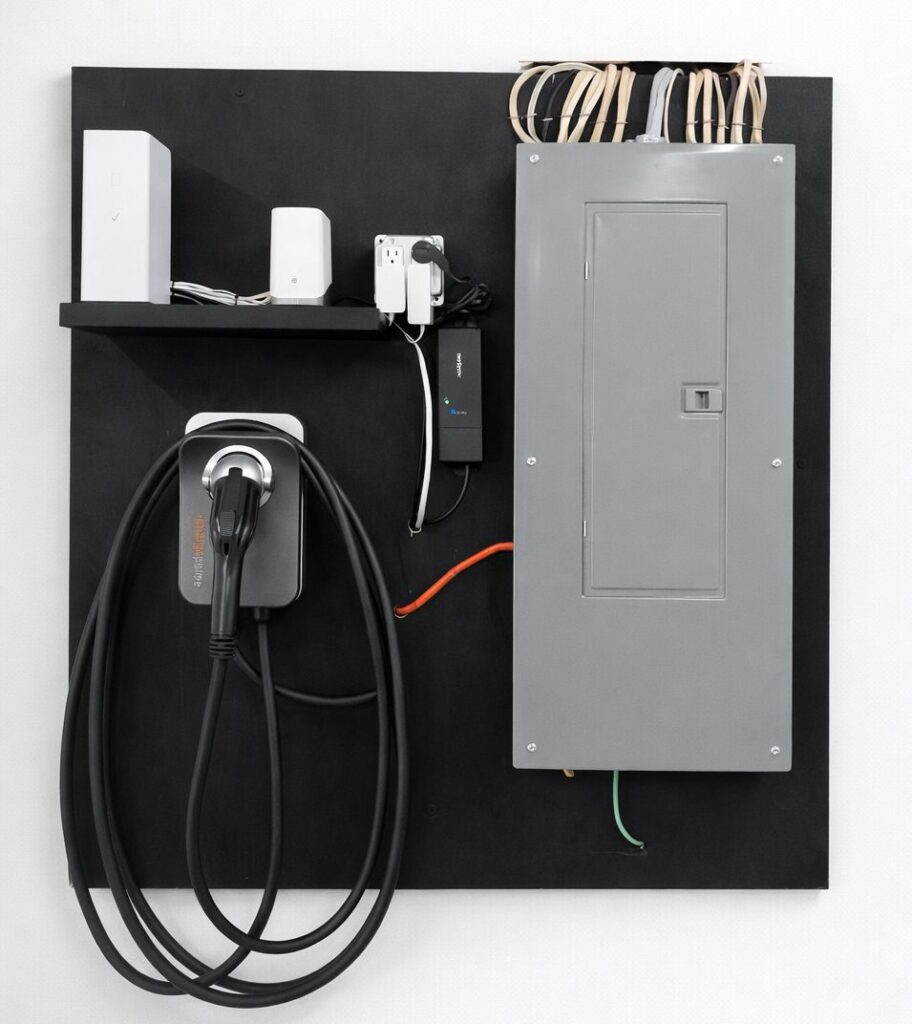
Choosing a charger and the right circuit size
Level 2 chargers come in different power levels, measured in amps. The circuit we install has to be bigger than what the charger pulls, because the charger runs for hours at a time. Here is the plain version:
- 32-amp charger on a 40-amp circuit: fine for most daily driving.
- 40-amp charger on a 50-amp circuit: the most common setup we install.
- 48-amp charger on a 60-amp circuit: the fastest home setup, popular with the Tesla Wall Connector and larger EVs.
Faster is not always better. Every car has a limit on how fast it can take a charge, so a bigger charger will not help a car that cannot use it, and it may push you toward a panel upgrade you do not need. We check your car and your panel and recommend the size that fits both.
Hardwired or plug-in? A plug-in charger uses a heavy-duty outlet, usually called a 14-50. A hardwired charger is wired straight to its circuit. We recommend hardwiring for most homes: it allows the faster 48-amp setting, it removes an outlet that can wear out from hours of heavy use, and the code adds extra protection requirements to an EV outlet that can make plug-in cost more than you expect.
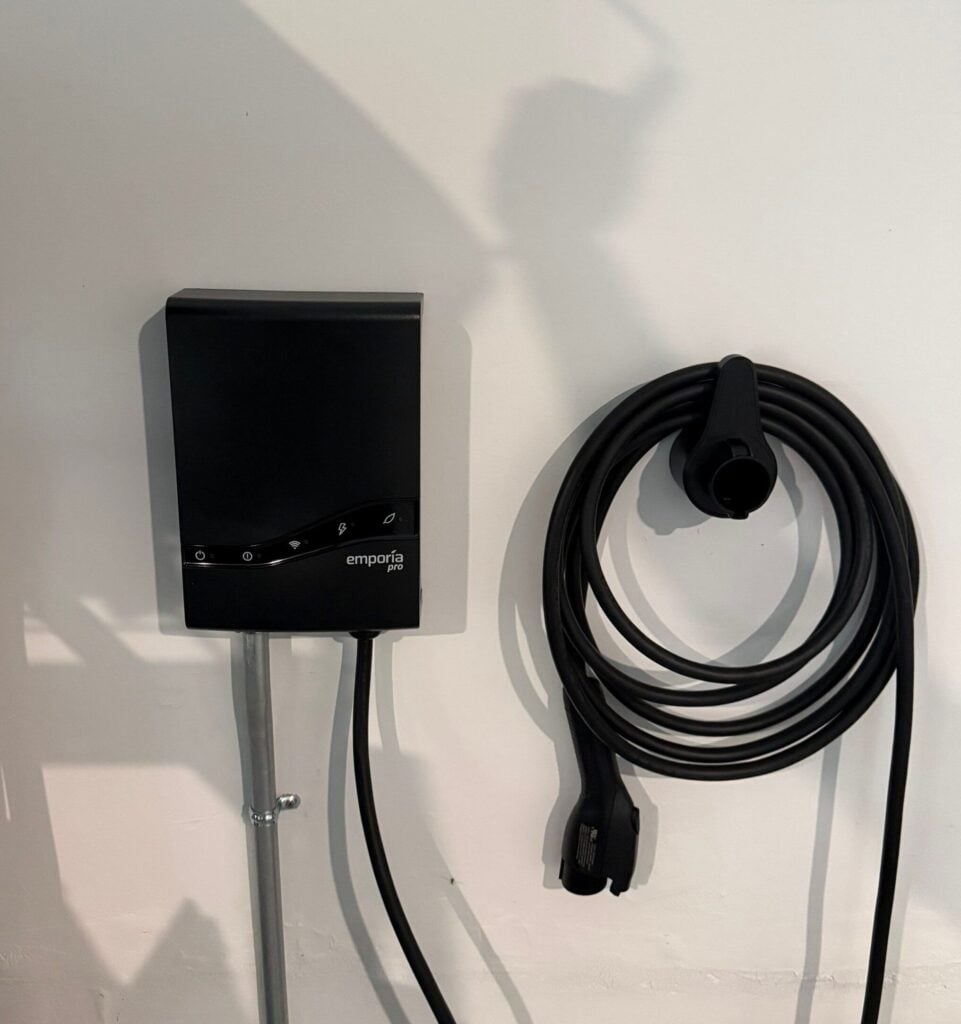
Brands. We are a Tesla Certified Installer and a certified ChargePoint and Emporia installer, and we install other brands too. If you want a PSE&G incentive, buy an ENERGY STAR certified smart charger that connects to Wi-Fi, because the program requires it.
Will your electrical panel handle an EV charger?
On a home with 200-amp service, the answer is usually yes. On a home with 100-amp service, especially with central air or an electric dryer, it is often tight. Before we quote, we add up what your home already uses and what the charger will add. That leaves three honest options:
- It fits. We add the circuit and you are done.
- It fits with a smart limiter. A load management device, or a charger with power sharing built in, slows the charger down when the house is using a lot of power, then speeds it back up. This can avoid a panel upgrade.
- It needs a panel upgrade. If the panel is old, full or too small, we will show you why. Read our complete guide to panel upgrades in New Jersey.
Do you need a permit for an EV charger in New Jersey?
Yes. Adding a 240-volt circuit for a charger is electrical work that needs a permit from your township’s construction office, followed by an inspection. We file the permit, meet the inspector and send you the approval. The permit also matters for money: PSE&G’s EV incentive requires a municipal permit and a passed electrical inspection, so an unpermitted install can cost you the credit (PSE&G).
If you live in a condo or townhome, check with your association before the install. Many have rules about where a charger can go and who pays for the power.
EV charger rebates and incentives in New Jersey (2026)
Incentives have changed a lot in the past year. Here is where things stand as of October 2026:
- PSE&G customers: PSE&G’s residential EV program offers an on-bill credit of up to $1,500 per charger for the wiring work on your side of the meter. You pay for the charger. It requires an ENERGY STAR certified Level 2 smart charger, a New Jersey licensed electrician, and a permit and passed inspection. PSE&G’s separate off-peak charging credit closed to new sign-ups in January 2026 and ended October 1, 2026 (PSE&G EV program).
- JCP&L customers: JCP&L’s residential charger rebate closed on June 30, 2025. JCP&L still lists a time-of-use credit for off-peak charging with a qualified Level 2 charger (JCP&L EV FAQ).
- Federal tax credit: The federal tax credit for home chargers expired for chargers installed after June 30, 2026 (Rewiring America).
Programs change often, so ask us before you buy a charger. We will tell you what applies at your address and help with the paperwork after the install.
“Amazing service! I was able to contact the electrician even after the charger installation was complete and he assisted me through my charger rebate process as well. It was very easy to get into contact with them and they were very professional. Highly recommend.”
How long an EV charger installation takes
Most home installs are done in one day, often in a few hours when the charger is close to the panel. Long runs, trenching or work through finished walls can take longer. If a panel upgrade is needed, plan for that first, since it brings its own permit and utility scheduling. The permit and inspection usually add a few days to a couple of weeks around the install, depending on your township.
What happens on install day, step by step
- Walk-through. We confirm where the charger goes, how the cable reaches the car, and the path for the wire.
- Power off to the panel for a short time while we add the new breaker.
- Run the wire from the panel to the charger, inside walls or in a neat metal pipe along the wall where it cannot be hidden.
- Mount the charger at a good height, close enough that the cable reaches the charging port without stretching.
- Set it up. We set the charger to match the circuit, connect it to your Wi-Fi if it is a smart charger, and help you set up the app.
- Test with your car. We plug in, confirm it is charging at the right speed, and show you how it works.
- Inspection. We meet the township inspector and send you the approval, which you will need for any PSE&G credit.
Common mistakes to avoid
- Buying the charger before checking the panel. A 48-amp charger on a full 100-amp panel can turn a simple job into a panel upgrade. Talk to us first.
- Buying a charger that does not qualify. If you are a PSE&G customer, an uncertified or non-smart charger can cost you up to $1,500 in credits.
- Skipping the permit. No permit means no PSE&G credit, and it can cause problems with insurance or when you sell.
- Using an extension cord or a dryer outlet adapter. These are not made for hours of heavy charging and can overheat.
- Putting the charger where the cable will not reach. Think about which side your charging port is on and whether you back in or pull in.
Why homeowners across New Jersey call Spartan Home Pros
We are a licensed and insured electrical, heating and air conditioning company, a Tesla Certified Installer, and a certified ChargePoint and Emporia installer. Our own crews do every install, never subcontractors. You get a flat price before we start, our team answer the phone 24/7, and 500+ five-star Google reviews back us up. We check your panel first, so you only pay for panel work if your home truly needs it. See our EV charger installation service page for more.
EV Charger Installation in Basking Ridge, Warren, Long Hill and Nearby Towns
Most Level 2 charger installs in these towns land in the price range above, and we check your panel first so the charger runs safely.
Our Bridgewater office handles EV charger installation in Bernards Township (Basking Ridge, Liberty Corner and Lyons), Bedminster and Pluckemin, Warren, Bridgewater and Martinsville, Chester, and Long Valley in Washington Township. Call or text (908) 287-2187.
Our Chatham office covers EV charger installation in Long Hill Township (Millington, Stirling, Gillette and Meyersville), Berkeley Heights, Murray Hill and New Providence. Call or text (908) 493-9223.
Questions homeowners ask about EV chargers
How much does it cost to install an EV charger at home in New Jersey?
Most Level 2 home charger installations in New Jersey get a flat price before we start. The biggest factors are how far the charger is from your electrical panel, whether the wire runs through open or finished space, and whether your panel has room for a new 240-volt circuit. If you need a panel upgrade, that is a separate job, quoted as a flat price after we see the panel.
Do I need a permit to install an EV charger in New Jersey?
Yes. A Level 2 charger needs a new 240-volt circuit, and that needs an electrical permit from your township’s construction office and an inspection. We handle both. The permit and passed inspection are also required for PSE&G’s EV credit.
Do I need a Level 2 charger, or is Level 1 enough?
Level 1 plugs into a regular outlet and adds only a few miles of range per hour. It can work if you drive under about 30 to 40 miles a day. Level 2 adds roughly 20 to 40 miles per hour, so most cars are full by morning. Most commuters, truck owners and two-EV families are happier with Level 2.
What size circuit does a Level 2 charger need?
It depends on the charger. A 32-amp charger needs a 40-amp circuit, a 40-amp charger needs a 50-amp circuit, and a 48-amp charger, like a Tesla Wall Connector at full speed, needs a 60-amp circuit. We match the circuit to your charger, your car and your panel.
Will I need a panel upgrade for an EV charger?
Not always. Homes with 200-amp service usually have room. Homes with 100-amp service may need a panel upgrade, or a load management device that slows the charger when the house is using a lot of power. We check before we quote, so you only pay for panel work if you truly need it.
Are there rebates for home EV chargers in New Jersey?
As of October 2026, PSE&G offers an on-bill credit of up to $1,500 per charger for the wiring work, with rules like an ENERGY STAR certified smart charger, a licensed electrician and a passed inspection. JCP&L’s residential charger rebate closed in June 2025, and the federal tax credit ended for chargers installed after June 30, 2026. Programs change, so ask us before you buy.
Should my charger be hardwired or plugged in?
For most homes we recommend hardwiring. It allows the fastest 48-amp setting, there is no outlet to wear out from hours of heavy use, and it avoids extra protection the code requires on EV outlets. A plug-in setup can make sense if you plan to take the charger with you when you move.
How long does an EV charger installation take?
Most installs are done in one day, often in a few hours when the charger is close to the panel. Long runs, trenching or finished walls take longer. The permit and inspection usually add a few days to a couple of weeks around the install.
When should I upgrade my electrical panel?
Consider an upgrade if your panel is 60 or 100 amps, uses fuses, has no room for new breakers, or is a brand known for problems. Adding an EV charger, a heat pump or a hot tub often means an upgrade too. Every panel upgrade gets a flat price after we see your panel. Signs you need a new panel.
Ready to charge at home? Call or text Spartan Home Pros at (908) 287-2187 for a flat price on your EV charger installation. Calls are answered 24/7, and we install chargers across Monmouth, Middlesex, Somerset, Union and Morris counties.